







Despite the fact that this post is about astronomy activities for middle school… it’s time for a little confession.
I’m not that into space.
I can hear the science teacher gasps from here!
I know, I know. Space is cool and all, but I’m just more into things I can experience firsthand.
Luckily for me, my husband is also a science teacher and he is waaaaaay into the waaaaaay out there. He loves all things astronomy, especially if you add in a little UFO chat. It’s one of his favorite subjects to teach.
Over the years, we’ve collaborated to bring some astronomy subjects to life. Ok… I say we collaborated, but… he gave me some ideas and I ran with them!
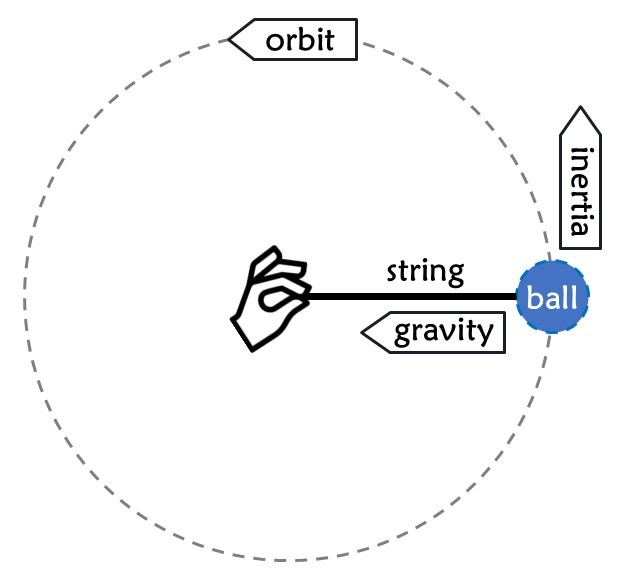
Here’s a quick demo that really helps kids to understand WHY planets stay in their orbits. This simple demo uses just a ball on a string to show students how gravity and inertia keep planets in their paths through space.
Attach a ball (like a wiffle ball or a pickle ball) to a string. Spin the ball while holding the string taut. The string represents gravity, while the spinning shows the planet’s forward motion (inertia). Students instantly see why planets don’t fly away or fall into the Sun.
It’s a balance between gravity and inertia!
While spinning, ask students what would happen if:
You can ask your students which part of the demo represents the Sun. (Your hand.)
That’s it! In just five minutes, students grasp one of astronomy’s fundamental concepts.
I do love to write science readings no matter what the topic, so I created some attention-grabbing articles.
The “Top 10” format always makes my Discoveries in Astronomy and Weird Space Facts a hit with kids. And kids love nothing more than to be grossed out by my Health Risks in Space article!
How do you make the intangible… tangible?
You can’t touch the galaxies or the universe, but you can have students put themselves in the shoes of an astronomer. In my Galaxies Activity, kids are challenged to classify galaxies by shape just as an astronomer would.
And wrapping your mind around the size and scale of our solar system is hard for us as adults, never mind kids. My To Scale Solar System Poster Project shows kids the almost unimaginable distances in space.
Another fun way to make astronomy feel a little more real is to have students calculate their weight (and the weight of a zebra…) on different planets with my Weight on Other Planets Activity.
If you’re looking to add a bit of RIGOR, I’ve got lessons for that, too.
Graphing is a skill that (as I mention probably too often) is lacking in kids these days. I try to add graphing practice as much as possible to my lessons.
For example, in my Graphing Gravity Activity, I have kids graph mass versus gravity and distance versus gravity to bring home these relationships. And in my Graphing Sunspots Activity, students graph sunspot data by year to discover the solar cycle for themselves.
Another way to add rigor is to have kids practice making claims from evidence. My Objects in the Universe CER Activity has kids analyze data tables and graphs to make claims.
Looking for a hands-on project for astronomy?
Try having kids build their own telescope! I describe the whole process in my telescope blog post. It includes a link to a free handout for kids and all the details you need to make the project successful.
Take a look to see if you think your students would enjoy it!

I hope you’ve found something that’s FAR OUT FUN to add to your astronomy unit!
As an Amazon Associate I earn from qualifying purchases.