
A GUEST BLOG!
Every teacher knows the challenge: how do you make learning stick long after the test is over?
We spend countless hours planning lessons, building activities, and preparing students for assessments. But when former students look back on their school years, it usually isn’t a worksheet, activity, or even a great lesson they remember most. It’s the experiences! And often, it’s the moments when learning stepped outside the classroom.
That’s why I’m excited to introduce my guest blogger, Lisa Meschutt, NYS STEM Master Teacher and Student Travel Specialist. Lisa has spent decades leading extended student trips and has seen firsthand how powerful multi-day travel experiences can be for students.
In this post, Lisa explains why overnight trips offer something that traditional classroom learning simply can’t: deep engagement, independence, and memories that last a lifetime.
When educators think about taking students off campus, the first image that often comes to
mind is a one-day field trip: a museum visit, a zoo tour, a local science center. These
experiences can be valuable—but they barely scratch the surface of what extended, multi-day
student trips can offer.
Overnight trips — whether they last several days or a full week — create a depth of learning and
growth that simply isn’t possible in a single afternoon away from school. For middle school and
high school teachers, these experiences can be transformative for students academically,
socially, and personally.
Extended trips immerse students in learning rather than interrupting it. When students spend
multiple days engaging with historical sites, ecosystems, cultural institutions, or service projects,
they move beyond passive observation.
Instead of “seeing” content, students live it:
This sustained exposure strengthens retention and makes abstract concepts tangible. Many
teachers report that students reference these trips months — or even years — later, long after
worksheets and quizzes are forgotten.
Prolonged trips push students out of their usual routines in healthy ways. Away from home and
the familiar structure of school, students must:
For middle schoolers, this is often a first taste of independence. For high schoolers, it’s
preparation for college, careers, and adult life. Students rise to the occasion when given responsibility — and teachers often see new confidence emerge in students who may struggle
in traditional classroom settings.
One of the most powerful outcomes of extended trips is relationship-building.
Students bond with each other. Spending multiple days together fosters teamwork, empathy,
and collaboration. Social barriers often break down, allowing students to connect with peers
they might never interact with at school. Friendships bloom with kids who have seen each other
in the halls but never took the time to get to know each other. On several trips, I’ve heard a kid
say, “I never knew _ was so much fun to be around!”
Teachers see students differently. Outside the classroom, students reveal new strengths —
leadership, curiosity, kindness, resilience. These insights can positively reshape teacher-
student relationships long after the trip ends.
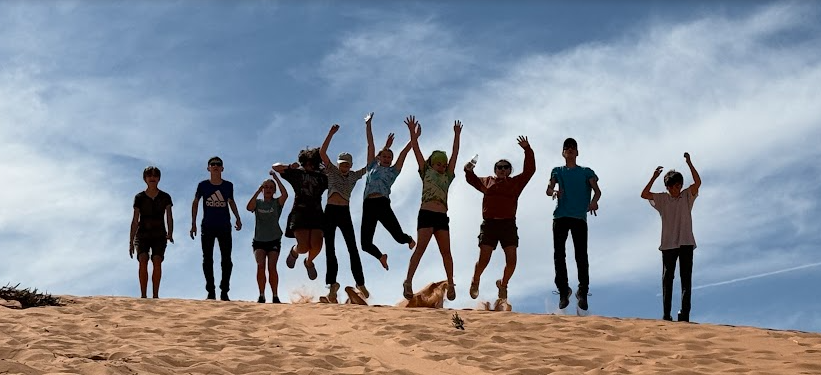
Extended trips naturally support social-emotional learning:
Because these lessons happen in real contexts — not scripted activities — they tend to be more
meaningful and authentic. Students learn about themselves and others in ways no lesson plan
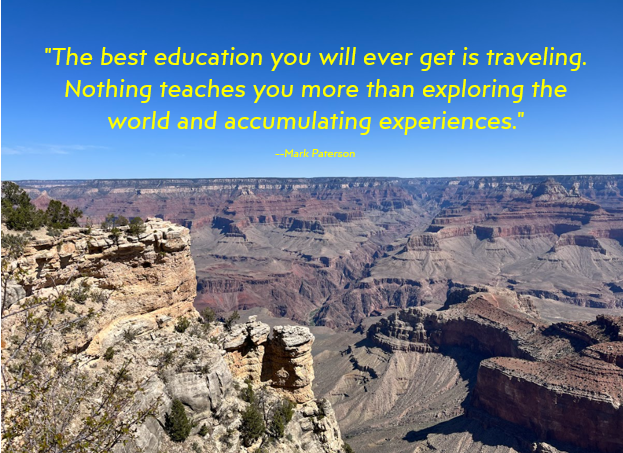
can fully replicate. Parents have often told me that their child returned from the Grand Canyon
with more maturity and a sense of responsibility. Students have told me their parents seemed to
trust them more.
Not every student thrives in a desk-and-paper environment. Off-campus learning experiences
often engage:
These experiences can reframe how students see themselves as learners — and how teachers
see them as well.

These trips don’t just enrich the days students are away — they enhance learning back at
school. Teachers often notice:
Trips become shared reference points that strengthen curriculum and classroom culture
throughout the year.
Isn’t it a sad irony that the one thing we teachers are trained the most and judged on the most
by our administrators – lesson planning and standardized test preparation and scores – is the
thing our students remember the least? I’ve been teaching for over 30 years and run into former
students frequently. They rarely talk about an individual lesson or what they learned in the
classroom but they always remember the trips. I bet you, yourself, can’t think of too many
individual lessons throughout your education. But I bet you can remember every field trip you
went on.
My answer is “yes” because the school offers many programs that not all can afford. Band
instruments cost money and as a parent, I spent way more on my boys’ sports equipment over
the years than their trip to the Grand Canyon cost. Our Foreign Language, Washington D.C.
and Grand Canyon trips are just additional offerings for students and families that are interested.
And when you’ve been doing them for so long, families have been literally known to start saving
for them in their child’s infancy.

There’s no denying that prolonged trips require planning, coordination, and courage. But I’ve
always used a company (Grand Classroom) that specializes in student travel to handle the
majority of the work and collection of payments. After 20 years of traveling with them, I’m
working for them to help other teachers provide this amazing opportunity for their students
because it’s the most rewarding thing I do as a teacher. The payoff is truly immense. These
experiences remind us why we teach in the first place: to help students grow not just
academically, but as people. And for many students, they become the moments they remember
forever.
In a time when education can feel increasingly constrained, student travel offers something
powerful — time, space, and experience for students to truly learn.
Please reach out to me if I can assist you in planning the adventure of a lifetime for you and
your students! Let’s give YOUR students a story to tell!
Visit my “GrandCanyonLady” social media accounts to learn more, or
www.GrandClassroom.com to see all of the extraordinary destinations we offer.

Questions? Email me at Lisa@grandclassroom.com or connect at the accounts below!