
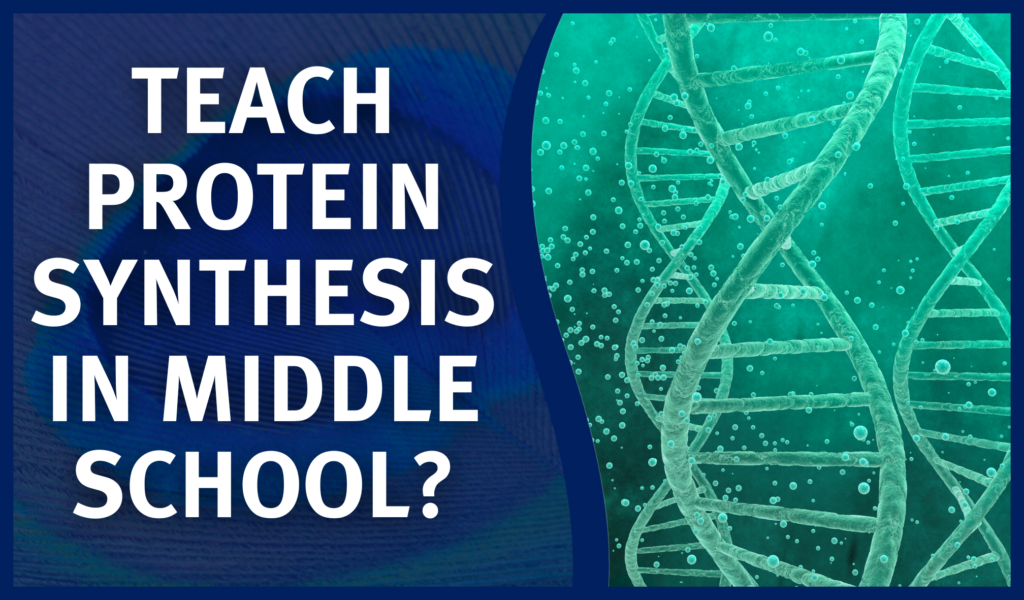
I’ve always found that kids universally love learning about DNA and genetics. It’s one of those topics that seems to spark a natural curiosity because it’s relevant to them – their traits, their family, and even the possibility of making their own monsters with traits like purple hair or three arms. It’s fun, engaging, and, let’s face it, a home run of a real-world connection. But teaching DNA in middle school brings a unique challenge. Should we also teach protein synthesis in middle school?
As much as students get excited about concepts like eye color and building dragons or monsters, I wonder: do they really understand how these traits come about? And, more importantly, do they grasp the true significance of DNA beyond surface-level features?
Sure, eye color and the ability to curl your tongue are interesting, but do students know what DNA actually codes for? Do they know that DNA is responsible for creating the proteins that make up who we are? That proteins are the real drivers behind the way our bodies function, look, and behave?
It was with these questions in mind that I set out to develop lessons that would give my students a deeper understanding of the true function of DNA. And yes, while protein synthesis may be a high school standard, that doesn’t mean middle school students can’t begin to develop a foundational understanding of the role proteins play in shaping life.
While the classic Mendelian genetics lessons (think Punnett squares and inheritance of traits) are fun and engaging, they often miss a critical piece of the puzzle: the role of proteins in our bodies. Many students understand that genes influence our traits – but they may not realize that it’s proteins, created from the instructions in our DNA, that are actually responsible for those traits. DNA doesn’t just decide that you’ll have brown eyes or curly hair; it codes for the creation of proteins, and these proteins determine how those traits express themselves in our bodies.
That’s why I developed two middle school-level lessons that go beyond the basics and dive into the true importance of DNA.
In the lesson “Making a Protein,” I simplify the process of protein synthesis for middle school students. Instead of getting bogged down in complex biochemical processes, I focus on the bigger picture of how proteins are made and why they’re important.
We break down the journey from DNA to protein in a way that highlights how the genetic code is used to build proteins and how these proteins shape our physical characteristics and overall health. Students learn that their body is constantly making proteins that control everything from eye color to immune responses. By the end of the lesson, they understand that DNA doesn’t just store information about traits – it’s the blueprint for creating the proteins that define who we are.

The second lesson, “The Basics of Enzymes,” introduces students to enzymes and explains how they regulate nearly every function in our bodies. Enzymes are a type of protein that speeds up chemical reactions, making them essential to life. Without enzymes, the basic processes of life – like digestion, energy production, and even cell division – couldn’t happen at the necessary rate to sustain life.
In this lesson, we explore the role of enzymes in controlling vital processes and how they are produced from the genetic code in our DNA. It’s a fascinating way to show students how DNA is connected to their everyday lives, not just through the traits they inherit, but through the very biochemical processes that keep their bodies functioning.

If you’re like me, you’re always thinking about how to help your students connect the dots between science concepts and their own lives. The exciting part about teaching DNA and genetics isn’t just the fun of learning about eye color or curly fur, but the deeper understanding of how our bodies work. By teaching students about protein synthesis and enzymes, we move beyond the superficial and help them see the true power of DNA in a way that has real-world relevance.
These lessons not only make DNA more meaningful but also build a foundation for students to understand more complex topics like cell biology and biochemistry in high school.
Do you teach DNA and genetics at the middle school level? If so, I’d love to hear from you! Do you dive into the importance of proteins in your lessons, or do you stick to the basics of traits and inheritance? It’s always great to connect with fellow educators and learn about how others approach this fascinating topic!
As an Amazon Associate I earn from qualifying purchases.