As middle school science teachers, we’re always looking for ways to make our lessons more engaging and relevant. How can we EASILY and CONSISTENTLY make real-world connections to current events an active part of our classroom routine? The answer lies in a simple yet powerful current science news activity:
Science News Journals!
Why Incorporate Science News?
Before we dive into the “how,” let’s explore the “why.” Integrating current science news into your curriculum offers numerous benefits:
Relevance: It shows students that science is happening now, not just in textbooks.
Critical Thinking: Analyzing news articles helps develop media literacy and scientific reasoning skills.
Interdisciplinary Connections: Science news often intersects with social studies, math, and language arts.
Career Awareness: Students learn about various STEM careers and cutting-edge research.
Engagement: Real-world applications can spark interest in students who might otherwise find science “boring.”
Scientific Process Understanding: News articles often highlight the scientific method in action.
Global Awareness: Science news can broaden students’ perspectives on global issues like climate change or public health.
The Set Up
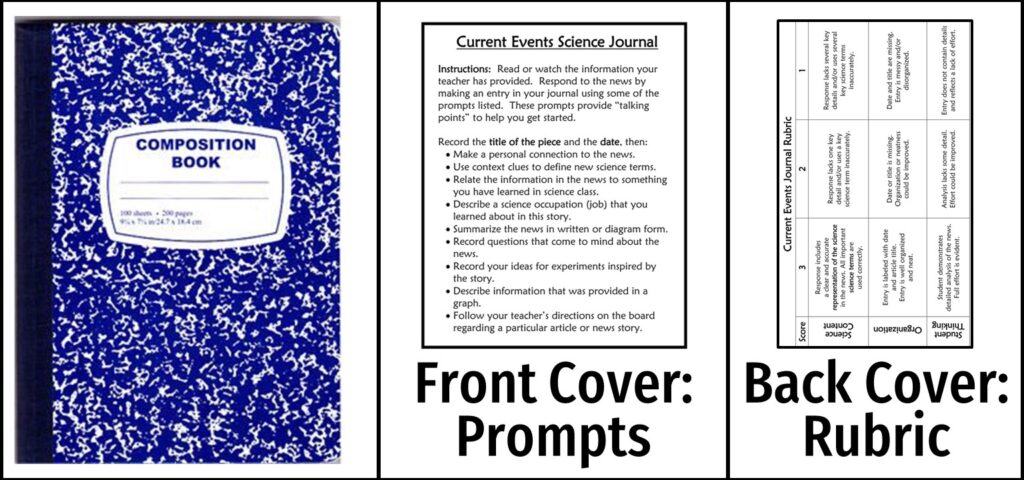
At the beginning of the year, I have students set up a composition notebookexclusively dedicated to science news. In the front cover, students glue a list of writing prompts to choose from. In the back cover, they paste a simple rubric. I keep a small bin (one for each class) for these notebooks in the classroom so that students don’t have to carry them around. To see more about how I have kids set up their notebooks, see this Instagram post.
How Kids Use Them
We have a very simple routine to use the science news journals. Each time I’m going to introduce the kids to some current science news, they know to quickly grab their journals from the bin. Then, they use their journal to respond to the news using one of the prompts on the given list – the list that’s stuck in their notebook. It’s an easy and painless routine to get into! Once you’ve explained the process the first time, it’s a breeze every time after.
Offer a variety of prompts to cater to different learning styles and interests:
Describe a science job you learned about in the story.
Record your ideas for experiments inspired by the article.
Use context clues to define new science terms.
Summarize the news in written or diagram form.
Explain how this discovery might impact your daily life.
Draw connections between this news and a previous lesson.
Identify potential ethical considerations related to the research.
Create a mock social media post to share this scientific discovery.
Design a simple infographic to explain the main concepts.
Write a letter to the researcher asking follow-up questions.
Finding Science News
Science news is easy to find! My go-to’s are:
Student-sourced: That student who always loves to give you a million and one facts – have them find you some links to what they’re telling you!
YouTube: Channels like SciShow, Veritasium, or NASA
Local newspapers: Look for stories on regional environmental issues or local scientists.
Science World magazine (Luckily, my school has a subscription)
Health & Medicine: Vaccine development, nutrition studies, medical breakthroughs
Tips for Success
Start small: Begin with just one science news day per week.
Be consistent: Choose a regular day for science news to establish routine.
Student choice: Allow students to bring in articles that interest them.
Cross-curricular collaboration: Partner with English teachers for writing skills or Social Studies for global impact discussions.
Differentiation: Offer articles at various reading levels or use text-to-speech tools for struggling readers.
Assessment: Use journal entries as formative assessments or occasional graded assignments.
Parental involvement: Encourage families to discuss science news at home.
By incorporating science news journals into your middle school classroom, you’re not just teaching science—you’re cultivating informed, curious, and engaged citizens of the future. Start small, stay consistent, and watch as your students develop a lifelong interest in scientific discovery!
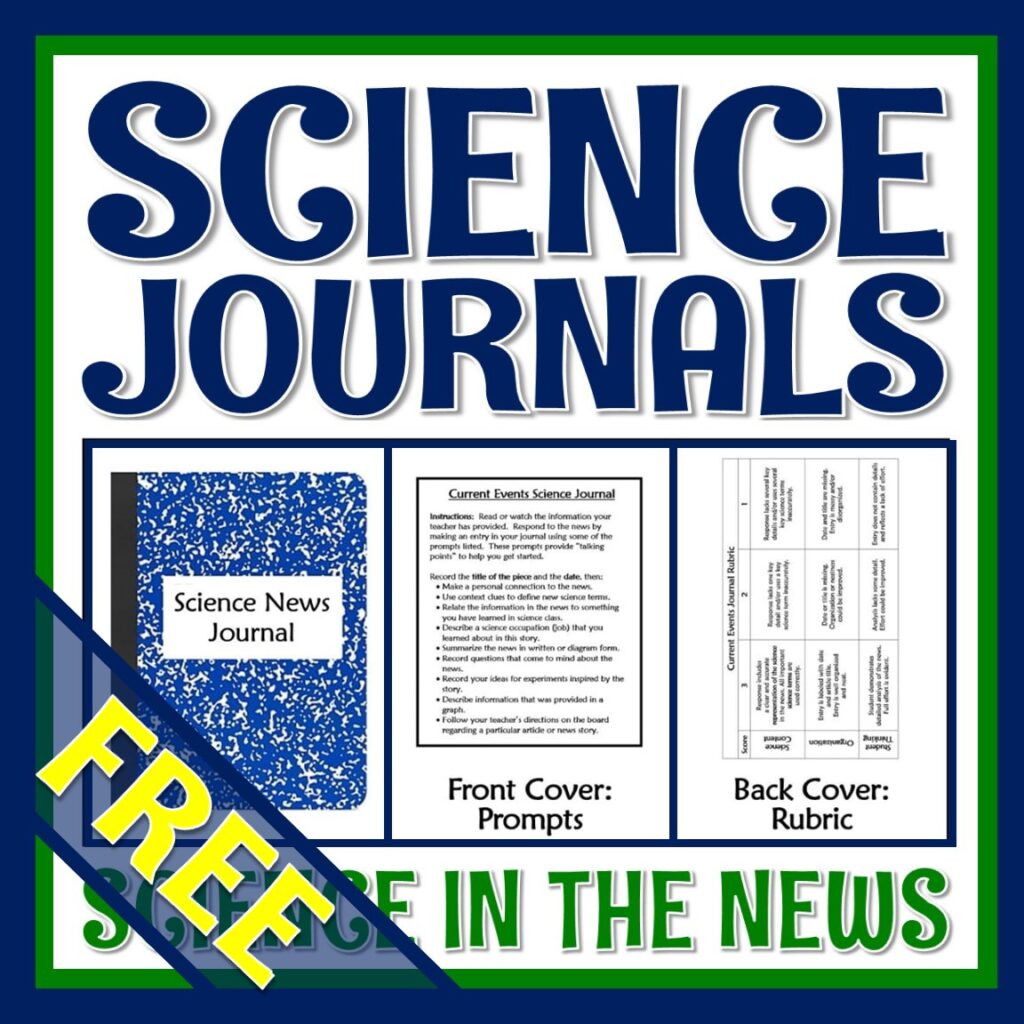
FREE Current Science News Activity
Click HERE to download the prompts and rubric I use as my current science news activity for FREE!
We use cookies on our website to give you the most relevant experience by remembering your preferences and repeat visits. By clicking “Accept All”, you consent to the use of ALL the cookies. However, you may visit "Cookie Settings" to provide a controlled consent.View Terms and Conditions
This website uses cookies to improve your experience while you navigate through the website. Out of these, the cookies that are categorized as necessary are stored on your browser as they are essential for the working of basic functionalities of the website. We also use third-party cookies that help us analyze and understand how you use this website. These cookies will be stored in your browser only with your consent. You also have the option to opt-out of these cookies. But opting out of some of these cookies may affect your browsing experience.
Necessary cookies are absolutely essential for the website to function properly. These cookies ensure basic functionalities and security features of the website, anonymously.
Cookie
Duration
Description
cookielawinfo-checkbox-analytics
11 months
This cookie is set by GDPR Cookie Consent plugin. The cookie is used to store the user consent for the cookies in the category "Analytics".
cookielawinfo-checkbox-functional
11 months
The cookie is set by GDPR cookie consent to record the user consent for the cookies in the category "Functional".
cookielawinfo-checkbox-necessary
11 months
This cookie is set by GDPR Cookie Consent plugin. The cookies is used to store the user consent for the cookies in the category "Necessary".
cookielawinfo-checkbox-others
11 months
This cookie is set by GDPR Cookie Consent plugin. The cookie is used to store the user consent for the cookies in the category "Other.
cookielawinfo-checkbox-performance
11 months
This cookie is set by GDPR Cookie Consent plugin. The cookie is used to store the user consent for the cookies in the category "Performance".
viewed_cookie_policy
11 months
The cookie is set by the GDPR Cookie Consent plugin and is used to store whether or not user has consented to the use of cookies. It does not store any personal data.
Functional cookies help to perform certain functionalities like sharing the content of the website on social media platforms, collect feedbacks, and other third-party features.
Performance cookies are used to understand and analyze the key performance indexes of the website which helps in delivering a better user experience for the visitors.
Analytical cookies are used to understand how visitors interact with the website. These cookies help provide information on metrics the number of visitors, bounce rate, traffic source, etc.
Advertisement cookies are used to provide visitors with relevant ads and marketing campaigns. These cookies track visitors across websites and collect information to provide customized ads.