No textbook? Or, does your textbook cover too much or too little? Get FOUR WEATHER READINGS for middle school to cover weather topics for a MIDDLE SCHOOL audience. These weather texts have EVERYTHING you need to cover NGSS MS-ESS2-5: Collect data to provide evidence for how the motions and complex interactions of air masses result in changes in weather conditions.
Build on Knowledge One Reading at a Time: Your students will understand weather by building on knowledge from one reading to the next. Each engaging weather reading also includes a corresponding worksheet with key terms and reading comprehension questions.
Each resource includes both a PRINT and a digital GOOGLE SLIDES option to assign.
Included Texts (Each with Its Own Worksheet):
-
Weather vs. Climate: Distinguishes between weather (short-term atmospheric conditions) and climate (long-term weather patterns), explaining how they differ in time scale and geographic scope.
-
What is Weather?: Explains the basic components of weather (temperature, humidity, precipitation, and air pressure) and how they interact to create daily weather conditions.
-
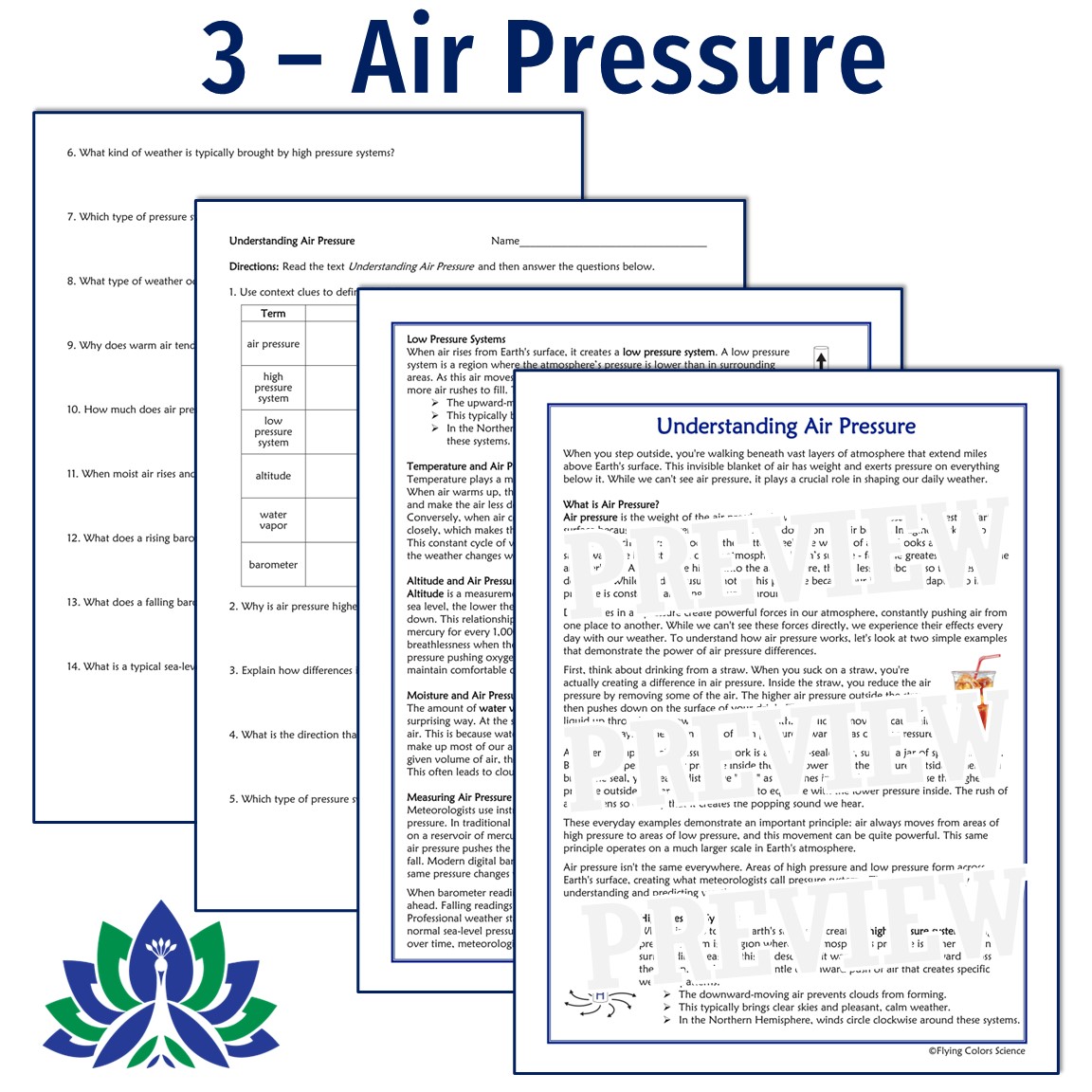
Understanding Air Pressure: Explores how differences in atmospheric pressure (high and low) create weather patterns through the movement of air masses and their effects on local and regional weather conditions.
-
Air Masses and Weather Fronts: Describes how different air masses interact along weather fronts to create various weather conditions, and how to read these patterns on weather maps.
Key Terms Covered Over the Four Texts:
- weather
- climate
- meteorologist
- climatologist
- temperature
- humidity
- relative humidity
- dew point
- precipitation
- rain
- snow
- sleet
- hail
- air pressure
- air mass
- weather front
- air pressure
- high-pressure system
- low-pressure system
- altitude
- water vapor
- barometer
Related Standard:
- NGSS MS-ESS2-5: Collect data to provide evidence for how the motions and complex interactions of air masses result in changes in weather conditions. Emphasis is on how air masses flow from regions of high pressure to low pressure, causing weather (defined by temperature, pressure, humidity, precipitation, and wind) at a fixed location to change over time, and how sudden changes in weather can result when different air masses collide. Emphasis is on how weather can be predicted within probabilistic ranges. Examples of data can be provided to students (such as weather maps, diagrams, and visualizations) or obtained through laboratory experiments (such as with condensation). Assessment does not include recalling the names of cloud types or weather symbols used on weather maps or the reported diagrams from weather stations.