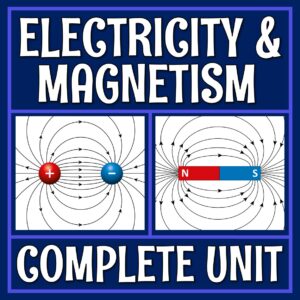
Looking for a more RIGOROUS and WELL-ORGANIZED magnetism lab? These magnetism activity stations are the familiar magnet activities you’ll find everywhere… but a little more elevated. And super easy to use!
⭐ Get this at a HUGE DISCOUNT in my COMPLETE ELECTRIC AND MAGNETIC FORCE UNIT! ⭐
Each of these stations gives students practice with a particular magnetism activity (magnetic field lines, paper clip chains, make an electromagnet, etc.) but then asks them to design their own simple experiment to answer a provided question. Once they have done their own simple experiment, they’ll answer the question in the Claims-Evidence-Reasoning format.
There are SEVEN stations/labs included. You’ll be familiar with the magnetism activities themselves – what’s different about this version is that it is more aligned with middle school rigor. Here are the stations:
Each station has TWO PARTS:
Materials Required:
Teacher Notes:
Related Standards:


$4.50
| Cookie | Duration | Description |
|---|---|---|
| cookielawinfo-checkbox-analytics | 11 months | This cookie is set by GDPR Cookie Consent plugin. The cookie is used to store the user consent for the cookies in the category "Analytics". |
| cookielawinfo-checkbox-functional | 11 months | The cookie is set by GDPR cookie consent to record the user consent for the cookies in the category "Functional". |
| cookielawinfo-checkbox-necessary | 11 months | This cookie is set by GDPR Cookie Consent plugin. The cookies is used to store the user consent for the cookies in the category "Necessary". |
| cookielawinfo-checkbox-others | 11 months | This cookie is set by GDPR Cookie Consent plugin. The cookie is used to store the user consent for the cookies in the category "Other. |
| cookielawinfo-checkbox-performance | 11 months | This cookie is set by GDPR Cookie Consent plugin. The cookie is used to store the user consent for the cookies in the category "Performance". |
| viewed_cookie_policy | 11 months | The cookie is set by the GDPR Cookie Consent plugin and is used to store whether or not user has consented to the use of cookies. It does not store any personal data. |