Original Post: https://eschooltoday.com/learn/what-is-a-natural-resource
Introduction to Natural Resources (NR)
Ever since the earth was inhabited, humans and other life forms have depended on things that exist freely in nature to survive. These things include water (seas and freshwater), land, soils, rocks, forests (vegetation), animals (including fish), fossil fuels, and minerals. They are called Natural Resources and are the basis of life on earth.
All these mentioned above are natural, and they exist in nature. No human created them. We tap into their supply to survive and also to function properly. Natural resources are all connected in some way. Therefore if one part was taken away, it would affect the supply or quality of all others. For example, if the water is eliminated from an area, the vegetation, soils, animals and even the air in that area would be affected negatively.
Below is a simple illustration of some great things that we get from some natural resources.
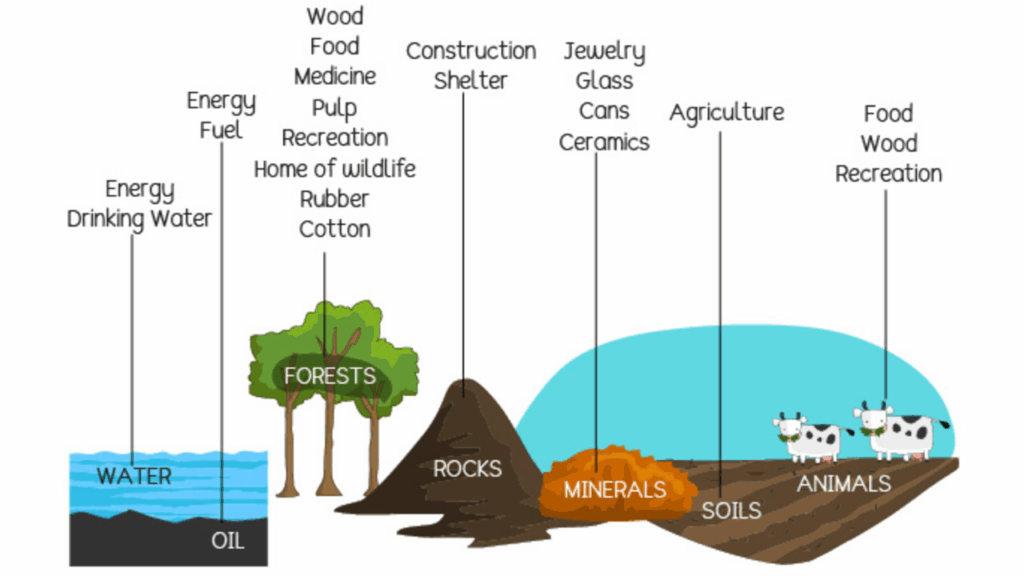
Natural resources can be consumed directly or indirectly. For instance, humans depend directly on forests for food, biomass, health, recreation, and increased living comfort. Indirectly forests act as climate control, flood control, storm protection, and nutrient cycling.
Raw Materials
Sometimes, natural resources can be used as raw materials to produce something. For instance, we can use a tree from the forest to produce timber. The timber is then used to produce wood for furniture or pulp for paper and paper products. In this scenario, the tree is the raw material.
Every item in your home is produced from a raw material that came from a natural resource. The tea mug, electricity at home, bread, clothes, you name them: each of them came from a natural resource.
Natural resources come in many forms. They may be solids, liquids, or gases. They may also be organic or inorganic. They may also be metallic or non-metallic. They may be renewable or non-renewable.
Types of Natural Resources
Natural resources fall under two main categories: Renewable and Non-renewable Resources. The table below will help us understand this better.

Renewable Resources
Renewable resources are those that are regularly available (like water) or can be reasonably replaced or recovered, like vegetative lands. Animals are also renewable because, with a bit of care, they can reproduce offspring to replace adult animals. Even though some non-renewable resources can be replenished, they may take many years, and that does not make them renewable.
Renewable resources that come from living things such as trees and animals can be called organic renewable resources.
Renewable resources that come from non-living things such as water, sun, and wind can be called inorganic renewable resources.
Non-Renewable Resources
Non-renewable resources are those that cannot be replaced once they are destroyed. Examples include fossil fuels. Minerals are also non-renewable because even though they form naturally in a process called the rock cycle, they can take thousands of years, making them non-renewable. Some animals can be considered non-renewable because if people hunt for a particular species without ensuring their reproduction, they will be extinct. That is why we must ensure that we protect resources that remain endangered.
Non-renewable resources can be called inorganic resources if they come from non-living things. Examples include minerals, wind, land, soil, and rocks.
Some non-renewable resources come from living things — such as fossil fuels. They can be called organic non-renewable resources.
Metallic and Non-metallic Resources
Inorganic resources may be metallic or non-metallic. Metallic minerals are those that have metals in them. They are harder, shiny, and can be melted to form new products. Examples include iron, copper, and tin. Non-metallic minerals have no metals in them. They are softer and do not shine. Examples include clay and coal.
Distribution of Natural Resources
Natural resources are not evenly distributed all over the world. Some places are more endowed than others — for instance, some regions have lots of water (and access to the ocean and seas). Others have lots of minerals and forestlands. Others have metallic rocks, wildlife, fossil fuels, and so on.
For example:
- The US has the world’s largest coal reserves with 491 billion short tons accounting for 27% of the world total. Australia is the world’s largest net exporter of coal, accounting for 29% of global coal exports
- China remains the largest producer of gold, with a 14% share of global production.
- The United States, Russia, and Canada are the leading producers of timber and pulp. Annual exports of primary and secondary wood products from tropical forests have exceeded US$ 20 billion in recent years, and further increases are anticipated.
Many countries have developed their economies by using their natural resources. Some also get a lot of income from their resources, in the form of tourism and recreation. Brazil and Peru, for example, make a lot of money from The Amazon Forests, which is super diverse in trees and animals.
Crude oil is another important natural resource. From Crude oil, we get many petroleum products such as petrol, diesel, and gas. We use these to fuel our cars and provide energy to warm and cool our homes. But Crude oil is not evenly distributed all over the world. Below is an illustration of how much each region of the world produces.
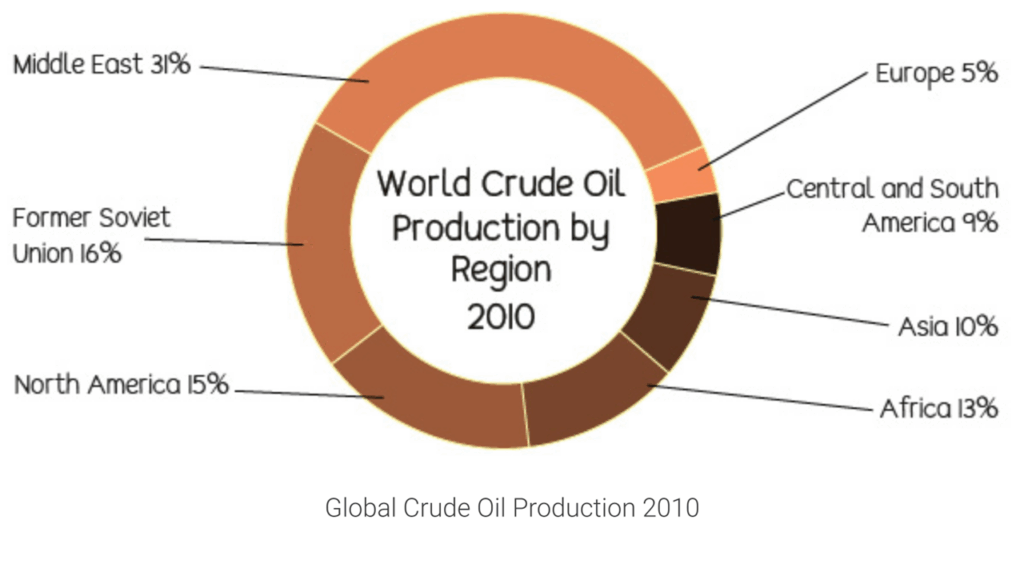
International and local trade has its roots in the fact that resources are not evenly distributed on the earth’s surface. Regions with crude oil can drill oil and sell to regions without oil, and also buy resources such as timber and precious metals (gold, diamonds, and silver) from regions that have them in abundance.
The uneven distribution is also the root of power and greed in many regions. Some countries use their wealth in resources to control and manipulate regions with fewer resources. Countries and regions have even gone to war over the management, ownership, allocation, use, and protection of natural resources and related ecosystems.
Threats to Natural Resources
A. Overpopulation
This is probably the most significant, single threat that natural resources face. The world’s population is increasing at a very fast rate. In the USA, a baby is born every 8 seconds, and a person dies every 13 seconds The increase in population means there will be pressure on almost all natural resources. How?
- Land Use:
With more mouths to feed and people to provide homes for, more land will need to be cultivated and developed for housing. More farming chemicals will be applied to increase food production. Many forests and vegetation lands will be converted into settlements for people, roads, and farms. These have repercussions on natural resources. - Forests:
Demand for wood (timber), food, roads, and forest products will be more. Therefore, people will use more forest resources than they can naturally recover. - Fishing:
The freshwater and seafood sector will face problems too as we will continue to depend heavily on them. Larger fishing companies are going deeper into the sea to catch fish in even larger quantities. Some of the fishing methods they use are not sustainable, thereby destroying many more fish and sea creatures in the process. - Need for more:
Human demand for a comfortable life means more items (communication, transport, education, entertainment, and recreation) will need to be produced. That means more industrial processes and more need for raw materials and natural resources.
B. Climate Change
The alteration in climate patterns as a result of excessive anthropogenic is hurting biodiversity and many other abiotic natural resources. Species that have acclimatized to their environments may perish, and others will have to move to more favorable conditions to survive.
C. Environmental Pollution
Land, water, and air pollution directly affect the health of the environments in which they occur. Pollution affects the chemical makeup of soils, rocks, lands, ocean water, freshwater and underground water, and other natural phenomena. It often has catastrophic consequences.
Problems Associated with Natural Resources
Even though natural resources are the support structures of life, too much or too little of it can come with a lot of trouble and conflict.
Too little natural resources:
In many regions of the world, a mix of limited resources, overpopulation, and environmental degradation has produced extreme poverty and income inequality. That, in turn, has fuelled grievances, rebellion, and conflict in society.
Too much natural resources:
This problem is even more in regions with excess natural resources. Greed, corruption, and conflict from revenue distribution, resource ownership, decision-making, management, and access have fuelled local and international conflict.
For example, in Papua New Guinea, The Panguna Copper Mine, once the largest open-pit mine in the world, was the center of violent conflict. Developed in the 1960s, locals were angry about the unfair salaries between local and foreign workers. They were also angry that the government did not give the community a fair share of revenues from the mine. They also had problems with foreign firms exploiting community resources. This conflict continued even after the mine was closed.
Conflict does not occur only in local communities. Third parties (including advanced nations) also have an extreme interest in wealth from natural resources in other regions. That often results in tensions between regions and countries, as well as foster or engage in civil conflicts.
For example, the civil war in the Democratic Republic of Congo (DRC), was partly fostered by neighboring states seeking raw materials. It is also believed that the actions of a French Oil Corporation (Elf) escalated the conflict in DRC.
What kind of natural resources are in your country, and do you think some nations are interfering with your country’s resources? What can your leaders do to ensure that there is no conflict from this scenario?
Credit: Original post accessed 8/01/2025 at https://eschooltoday.com/learn/what-is-a-natural-resource; reposted for classroom use only; ALL images and text are from eschooltoday.com